

Appreciating Peter Max (1937-2026)
Peter Max spent his career turning color, optimism, and cosmic imagery into a visual language that seemed to exist everywhere.
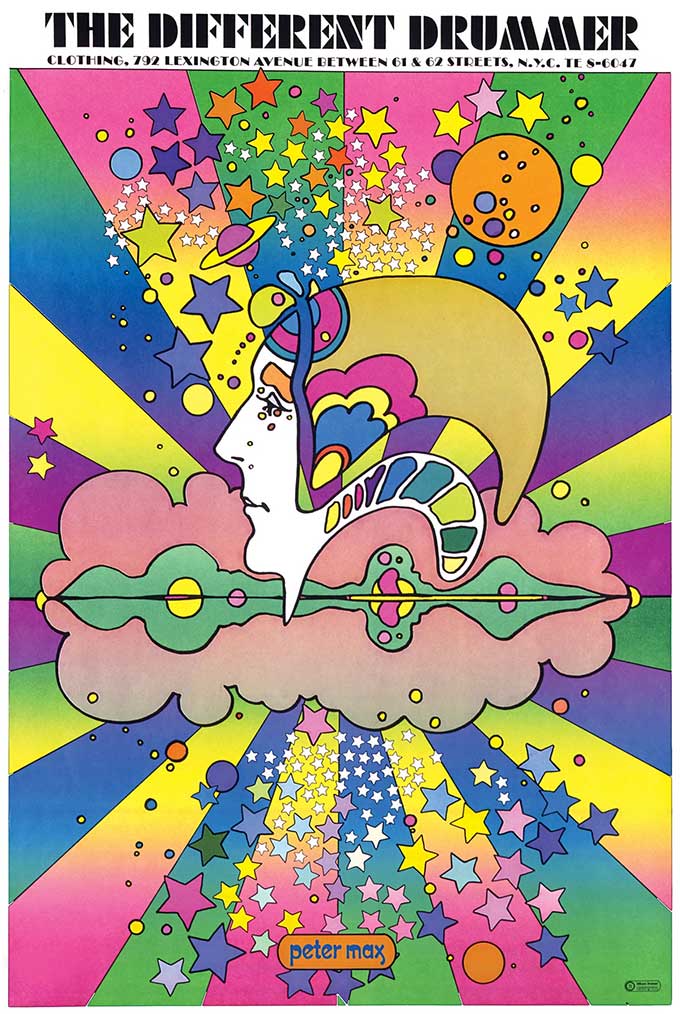
Different Drummer, 1968, Peter Max
From psychedelic posters to postage stamps, border murals, and the Statue of Liberty, his work became woven into the visual fabric of American culture. His evolution began long before the psychedelic posters that made him famous. Born in Berlin in 1937, Max’s childhood took him across continents before his family settled in New York. In 1953 at 16, his family spent six months in Paris on their way to the United States where his mother enrolled him in sketch classes at the Louvre. After arriving in New York, Max studied realism at the Art Students League under Frank Reilly before attending the progressive School of Visual Arts. By 1962 Max and his art-school friend Tom Daly had established a Manhattan studio that went on to receive awards for book-cover illustration and graphic design. There, Max began bringing together graphic design, abstraction, saturated color, and simplified forms, gradually developing the visual vocabulary that would eventually make him one of the most recognizable artists of the twentieth century.
After completing a formal education, Max’s artistic direction shifted dramatically in 1966 after he met Indian yoga master Swami Satchidananda during a trip to Paris – an encounter that would introduce spirituality and the idea of a “cosmic consciousness” deeply into his work. His fascination with astronomy combined with spirituality and the visual influences of Art Nouveau evolved into the psychedelic Pop Art and “Cosmic ’60s” imagery that defined his breakthrough. By the late 1960s Max had become a fixture of American popular culture. His posters, album covers, and commercial imagery appeared throughout the visual landscape of the era, while his work was increasingly compared to the hippie lifestyle and the music of artists such as the Beatles with whom he maintained a close friendship. In 1969 he appeared on the cover of LIFE magazine, which devoted eight pages to his work. Images such as Different Drummer and Love captured the era’s fascination with color, music, peace, spirituality, and cosmic possibility. Reproduced across posters, consumer products, and dormitory walls, Max’s imagery reached audiences far beyond the traditional art world.
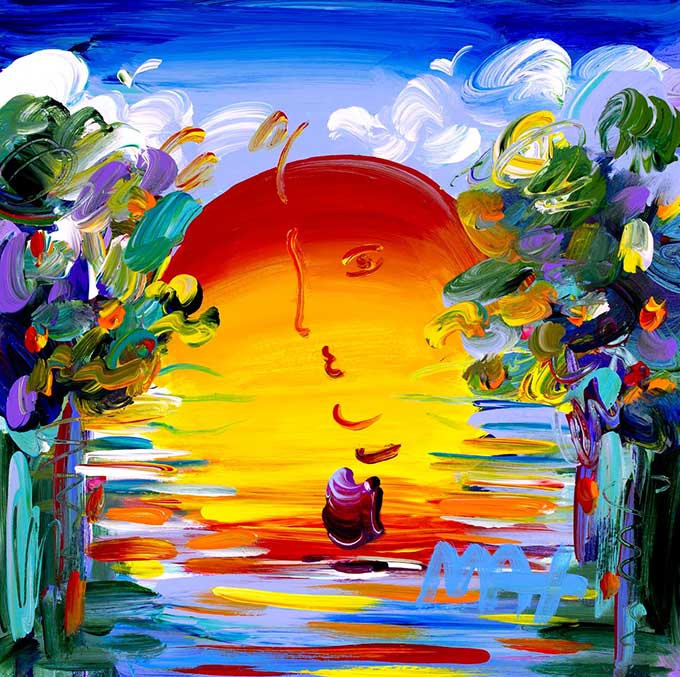
Better World, 1992, Peter Max
One of his most consequential projects came in 1974 when he was commissioned by the United States Postal Service to design the Preserve the Environment stamp for Expo ’74 the World’s Fair in Spokane, Washington. Over 130,000,000 of the ten-cent stamps were produced featuring Max’s iconic Cosmic Runner, also known as the Cosmic Jumper, alongside a rendition of another iconic Max motif, the Smiling Sage. The Cosmic Jumper was often used by Max as the embodiment of his fascination with movement, freedom of spirit, and cosmic exploration, while the serene Smiling Sage conveyed the optimism and spiritual consciousness that ran throughout his work. The figures and psychedelic colors translated the fair’s environmental message into Max’s instantly recognizable visual language. For an artist whose imagery had become associated with counterculture, having that language reproduced on an official piece of American communication represented a dramatic expansion of his audience.
The Cosmic Jumper was often used by Max as the embodiment of his fascination with movement, freedom of spirit…
The following years brought another major transformation. As Max became increasingly dissatisfied with the mass commercialization of his imagery, he pulled back from the commercial world surrounding his work and returned his focus to painting, moving toward acrylics, larger brushes, and a more spontaneous, expressionistic style. The 1976 United States Bicentennial gave him an opportunity to redirect his colorful visual language toward American identity. His Peter Max Paints America project celebrated the country’s history through paintings and collages, while the U.S. General Services Administration commissioned 235 Welcome to America murals for border entry points. These murals served as the initial point of contact for many first-time visitors, setting the tone for how America would be perceived and effectively making Max’s optimistic imagery a representation of the country itself.
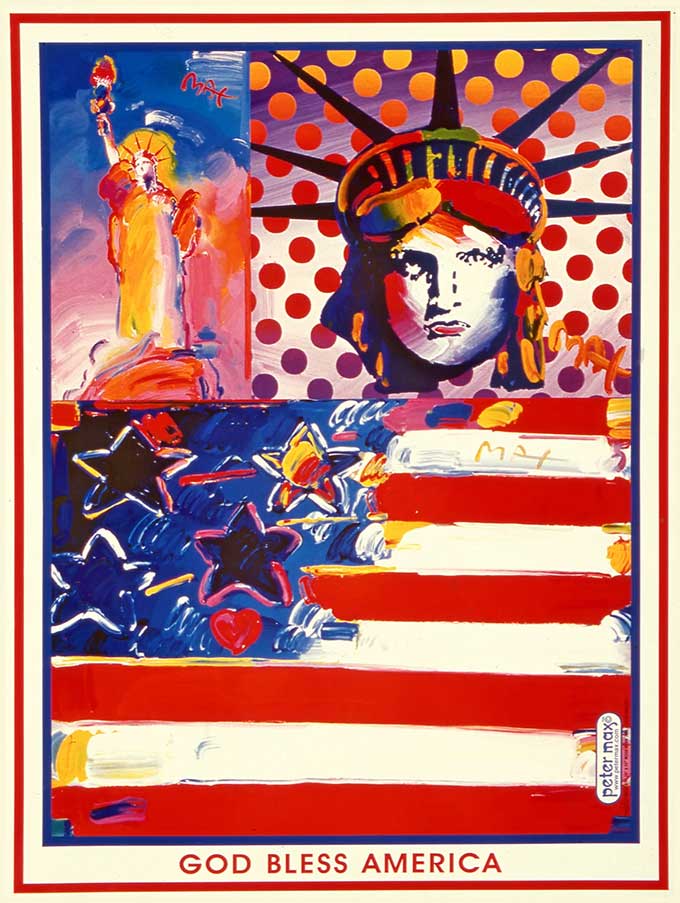
God Bless America, 2001, Peter Max
The shift toward American symbolism did not mean that Max had abandoned the ideals of his earlier work. Instead, he simply began expressing his familiar themes of freedom, optimism, individuality, and unity through a patriotic lens using symbols such as the American flag, historical figures, and, most significantly the Statue of Liberty. In 1981 President and Mrs. Ronald Reagan invited Max to the White House for his first of several visits, where he painted six eightfoot-tall portraits of Lady Liberty in the rose garden. Max’s fascination with the iconic statue continued into the 1980s restoration of the monument, culminating in the making of several large paintings on Liberty Island during the Statue of Liberty’s 1986 centennial celebration. The experience inspired his Liberty Head series where his influences of Fauvism, vibrant color, and energetic brushwork transformed one of America’s most recognizable symbols into something distinctly his own.
In 1981 President and Mrs. Ronald Reagan invited Max to the White House for his first of several visits…
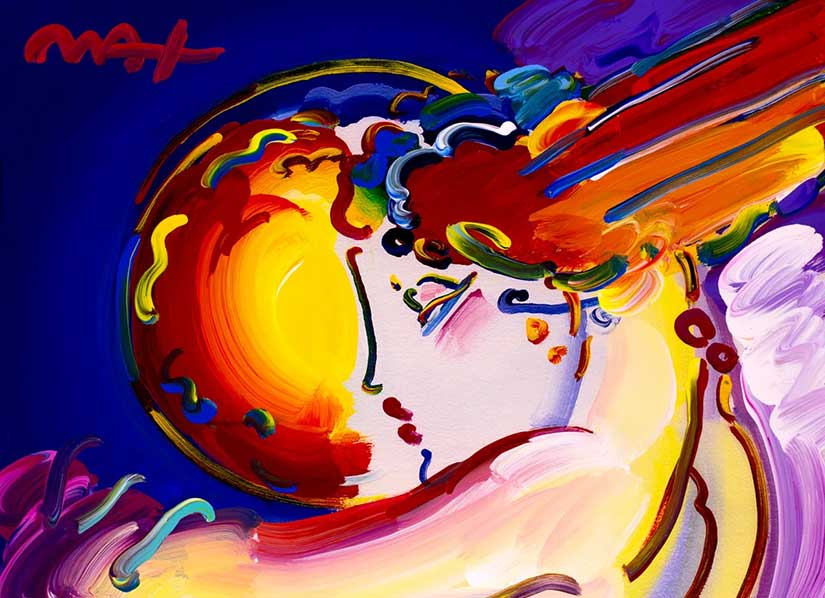
Yet Max never completely left the cosmos behind. In 1985 while backstage at the Live Aid concert in Philadelphia he sketched the concept for I Love the World after being moved by the event’s charitable purpose. The finished work, completed in 1999, depicts an angel embracing the Earth and demonstrates how the universal themes of compassion and cosmic connection that shaped his 1960s work continued to surface throughout his later career.
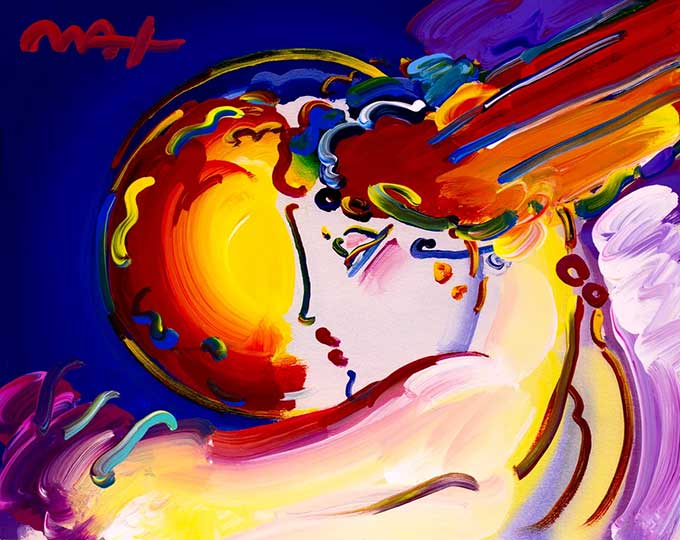
I Love the World, 1985, Peter Max
Max passed away in New York City on September 14, 2026 at the age of 88. His career reflects a larger-than-life legacy that spans decades across the world and will be revered for centuries to come. It was defined by this constant movement between the personal and the public, the cosmic and the patriotic, fine art and mass culture. Rather than remaining confined to one artistic movement he continually adapted the same fundamental vocabulary of color, optimism, spirituality, and possibility to the changing world around him. He took a visual language born from the counterculture and carried it into everyday American life. His Cosmic Runner could appear on a stamp, his Liberty paintings could hang in the White House, and his colors could fill a border mural welcoming people into the country. All of the work done by Max throughout his life was done in the name of peace and love, something we could all use more of these days. The loss of such an iconic figure feels almost representative of America’s current turmoil and can serve to inspire us to not let the message of unity get lost in a tumultuous world.
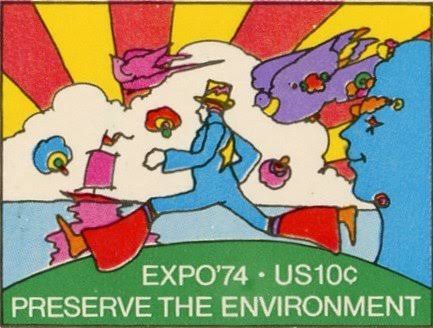
Preserve the Environment, 1974, Peter Max