


LACMA Rising
Approaching the Los Angeles County Museum of Art’s (LACMA) newly opened David Geffen Galleries for the first time was certainly intimidating.
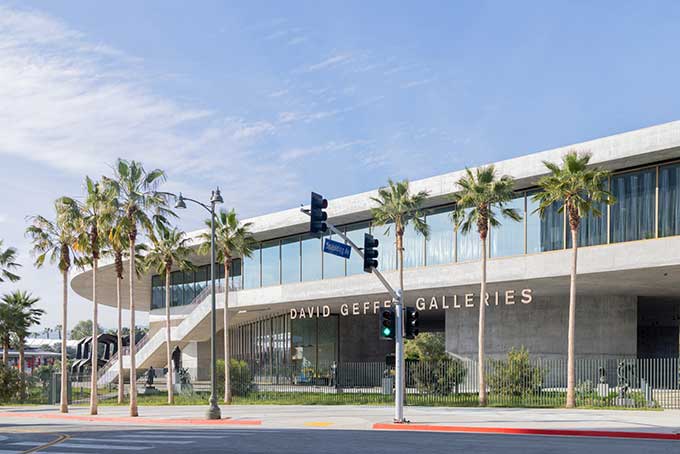 David Geffen Galleries, LACMA
Upon entry, the compelling brutal-minimalist structure looms overhead. Exposed lime-washed, slate gray concrete constructs stretching hundreds of feet down and across Wilshire Boulevard. Elevated about thirty feet in the air and anchored in place only by a few small structures beneath, the building appears to defy gravity in
an Olympian worthy balancing act – expertly and meticulously designed by Pritzker Prize winning architect Peter Zumthor and his team.
The press preview and ribbon cutting on an early Sunday morning began with a series of speeches from the developers of the galleries, including Michael Govan, LACMA’s CEO and Wallis Annenberg Director, Zumthor, community members, and Los Angeles County officials, where they described the vision for the project, noting their goal to stimulate a sense of community in Los Angeles. Created through the collaboration of over 10,000 hands, LACMA’s David Geffen Galleries is part of a two decade-long plan to revitalize the spirit of community in Los Angeles, centering creative thought, civic activation, and social engagement. Govan described their intention for the new addition to act as the “living room of Los Angeles” featuring cafes, outdoor spaces for socializing, entertainment, educational programs, and, obviously, the galleries which provide shade for communal areas down below. After the formalities had concluded, audiences dispersed for refreshments and access to the new galleries.
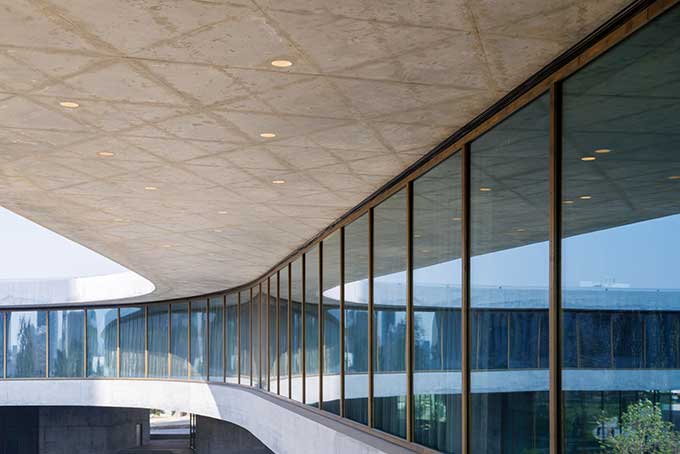
A monolithic staircase leads visitors to the entrance. With each ascending step, the breathtaking city view grew in its beauty as the air filled with anticipation. Adorned floor to ceiling with windows spanning the full perimeter, Zumthor invites the cityscape into the gallery space, illuminating works on the outskirts as natural light pours in from all sides, while other works are concealed behind walls that lead to dimly lit, intimate spaces.
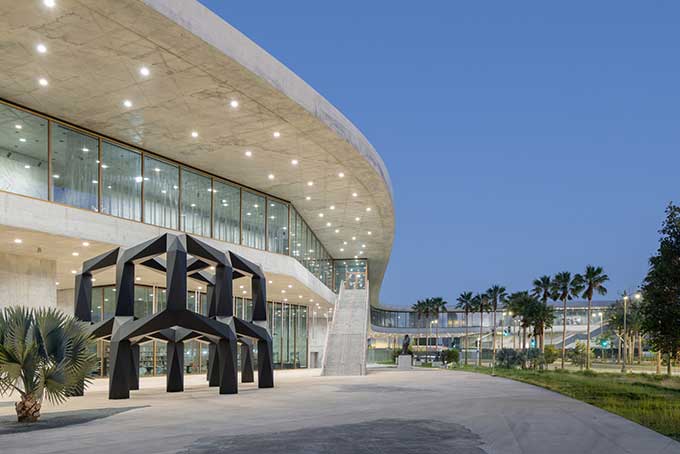 David Geffen Galleries, LACMA
Greeting visitors upon entering, Liz Glynn’s The Futility of Conquest (Cavalcade) sets the tone of the exhibits, reflecting upon the self-destructive nature of colonization and overstepping foreign boundaries. Just past this installation, Andreas Gursky’s Ocean series hints at the curatorial narrative of the exhibit. Rather than grouping works by country or timeline, LACMA’s expert team of over forty-five curators chose to center the concept on oceanic regions – highlighting how commerce has developed and blended cultures between borders through time as well as, contrarily, how some oceans serve the opposite effect – their immense vastness isolating certain parts of the globe. In an attempt to eliminate hierarchies between works and nations, the LACMA team chose to display all works side by side, allowing equal space for each to speak for itself. In addition, this exhibition defies Eurocentric definitions of fine art by including many works of craftsmanship that elevate the term “craft” to a fine art level, despite being historically undervalued.
Rather than becoming lost in the sands of time, many of these regionally unique traditions persevered despite tribulations…
Grouped into four major oceanic regions, each exhibit illustrates connections between different areas of the globe: Mediterranean, Pacific, Atlantic, and Indian. Among each grouping are subsections organized to elicit new contexts and connections between selections, pairing works, for example, that harmonize with one another despite being from completely different time periods and continental regions. When exploring the galleries for the first time, it can be difficult to decipher the deeper meaning behind these curatorial decisions as didactics are relatively sparse. After consulting the catalogue, Wander, a clearer understanding of the exhibition reveals itself.
The Pacific Ocean galleries highlight the effects of colonization starting in the 1500s where ancient traditions among Asia and the Americas were upended by European invasion. Rather than becoming lost in the sands of time, many of these regionally unique traditions persevered despite tribulations, often evolving through time to adjust to resource constraints, modernity, and colonial oppression.
 David Geffen Galleries, LACMA
In a similar vein to the Pacific, Atlantic Ocean commerce has historically, for the last 600 years or so, been deeply carved by colonialism. Based on the Atlantic wind calendar, a triangular trading system was set up – passing African slaves over to the Americas to cultivate raw materials that were then sent over to European nations while European goods were shipped over to the Americas and West Africa, and so on. This system was set up to exploit the natural and human resources of West Africa and the Americas, transferring wealth to Europe. These trade systems have had a profound effect on creative thought since this era. Skilled artisans from Africa and the Americas often shifted their regionally unique skillsets to fit European needs and, through working alongside one another in the Americas, they shared ideas and refined their crafts through cross-cultural dialogue. Additionally, the traumatic effects of colonialism among these nations creates a rich background for expressive artwork, often still exhibiting the scars of the past as communities rebuild cultural systems and connect with their ancestors.
This system was set up to exploit the natural and human resources of West Africa and the Americas, transferring wealth to Europe.
The Indian Ocean galleries center on coexistence. With a highly reliable wind calendar where directions switch on a consistent basis each year, trade routes have remained fertile with cultural and commercial exchange through time between the Middle East, East Africa, South and Southeast Asia, East Africa, and The Persian Gulf. It is one of the longest maintained trade routes in the world. Multiculturalism has deep roots among these continental regions and has historically shaped many aspects of life and artistry. A stark but fitting commonality between all four of these oceanic regions represented in the galleries is the cultural richness of port cities
throughout time, often serving as creative social hubs of innovation and diverse trades. Between Indian Ocean trade routes, sailors and merchants would reside for long periods of time away from home with round trip voyages often taking two years or more. This created the perfect environment for cultural enrichment and artistic diversity amongst port cities where people from widely spread apart origins gathered in dense metropolitan areas – bringing their unique lifestyles, resources, and merchandise with them to these new regions.
While not technically an ocean, the Mediterranean Sea historically has served as a critical connection point between Europe, North Africa, and Western Asia since before the Bronze Age, carrying resources and ideas between the three regions and contributing to the development of unique traditions and artistry for thousands of years. Mid-nineteenth century American sculptor William Wetmore Story embodies this cultural fusion while working in Italy in his 1858 displayed work Cleopatra. Depicting a relaxed form of the Egyptian pharaoh resting casually on a chair, adorned in her iconic Nemes headdress, Story executed this masterpiece through a traditionally Greco-Roman visual language evocative of marble sculpture spanning the Archaic to Roman periods (roughly 700 BCE- 400 CE). As an abolitionist, Story aimed to challenge concurrent Eurocentric neoclassical subject matter in favor of promoting diversity and cultural exchange between the neighboring regions by prodding at the active controversy over Cleopatra’s ethnic origins. Furthermore, this concept also illustrates the ways that colonialism has affected race relations through time. Before some of these trade routes like the Atlantic and Pacific were cemented in place, many nations had little to no concept of race which, when finally introduced, ultimately proved too much to handle for many and, despite so much positive cultural exchange, these trade routes also effectively chartered a path to countless atrocities and disagreements.
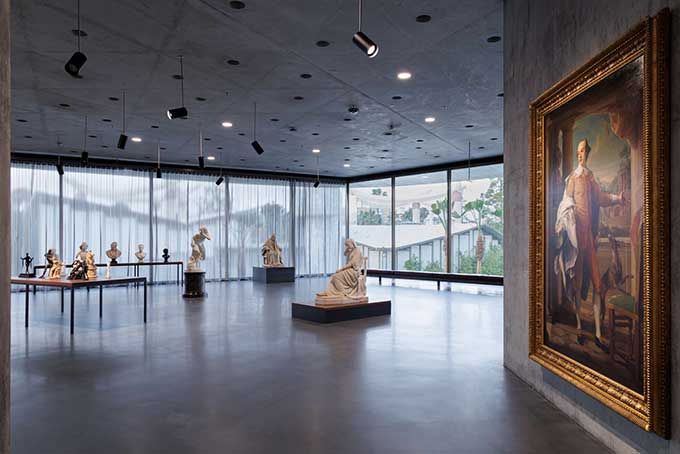 David Geffen Galleries, LACMA
Through this journey between the seas, many voices are heard. While gunning for this antihierarchical, diverse message, one can’t help but to consider the greater implications of the fine arts community onto the public. For centuries, civil activism has trended strongly in the arts while it simultaneously remains somewhat out of reach for the average citizen. The David Geffen Galleries hits the mark in many ways, however room for improvement awaits. For starters, the galleries campus is gated off from the public which, to be fair, aligns with safety concerns but begs the question: if this is meant to be the “living room of Los Angeles”, should these surrounding common areas still come with a pay wall? Especially given that roughly twenty percent of the over $724,000,000 dollar project was sourced from taxpayer funds and parking at the facility has a flat rate of over twenty dollars regardless of the day, the free admission offered to Los Angeles County residents a few days per week feels lackluster and teeters on virtue signaling.
Similarly, LACMA boasts about stimulating community and civic engagement all the while hosting an onsite Erewhon cafe. As one of the most expensive grocery stores in the United States, the brand has somewhat come to represent the wealth gap in our county where, on one hand, folks are spending over a hundred dollars for a day or two’s worth of groceries while on the other, so many native Angelenos remain in poverty, stretching just a few dollars for the week. Including this luxury brand arguably sets a standard for the people they seek to attract – and those they would rather keep away from their “living room.”
The David Geffen Galleries hits the mark in many ways, however room for improvement awaits.
Furthermore, the choice of a more brutalist style of architecture may fail to wow the public. Zumthor’s interest in concrete and its honesty as a material mimics modern ways of thought in terms of architecture, invoking minimalist and brutalist styles. While many art enthusiasts find appreciation for this philosophy and the way that the monochromaticity of raw materials emboldens displayed artwork, much of the general populous may be less than impressed by imposing, monolithic, raw concrete structures – often feeling them to be representational of dystopia – which only further promotes exclusivity and widens the divide between “sophisticated” creatives and the general public. Consequently, the distrust of brutalist language within the public eye is what directly led to its downfall after being coined in the mid 1900s.
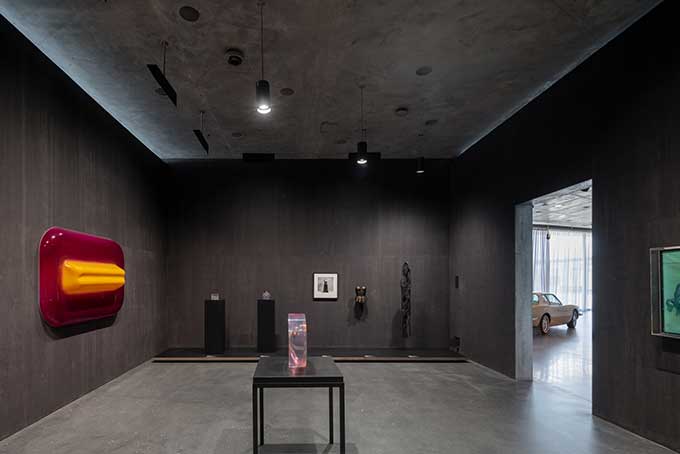 David Geffen Galleries, LACMA
Finally, there is one piece of art that makes one question the message behind the entire exhibit. Resting in the sculpture garden beneath the galleries is a massive sculpture of a woman’s face, mimicking Olmec tradition. Pedro Reyes’ Tlali reprises a failed 2021 public art proposal, originally meant to reside in Mexico City, that was shot down amid controversy on its accuracy in depicting Mexican indigenous women. As a non-indigenous man, Reyes has been questioned by critics on his ability, and place, to portray the given subject matter– feeling that his depiction lacked creativity and nuance. Missing the mark, Reyes’ work was meant to replace a statue of Christopher Columbus in Mexico City, but would never see the light of day. That is, until LACMA decided to accept the proposal to exhibit the watered-down work in a gallery intended to covet diversity and appears to have brushed off backlash from Mexican cultural authorities.
Despite these criticisms, LACMA’s new venture with David Geffen Galleries offers an extraordinary opportunity for the Los Angeles arts community. As programming expands and engagement with the public deepens, LACMA has the potential to be truly realized as the “living room of Los Angeles” by sharing a love of art with new audiences and encouraging viewers to see the world through new perspectives. Named the largest encyclopedic museum west of the Mississippi, this new look into the permanent collection brings rarely exhibited works from around the world into the public eye, connected through a theme that encapsulates the spirit of Los Angeles’ melting pot of cultures. The museum has laid an ambitious foundation with this new venture, and if it continues to evolve alongside the community it hopes to serve, its greatest achievements may still lie ahead.