


Oh, Beautiful Brutalism
Based on the French word for raw concrete, “beton brut”, the architectural style of brutalism began gaining traction in post-World War II Europe, amid the rise of modernism, and quickly became one of the most divisive architectural styles of its time.
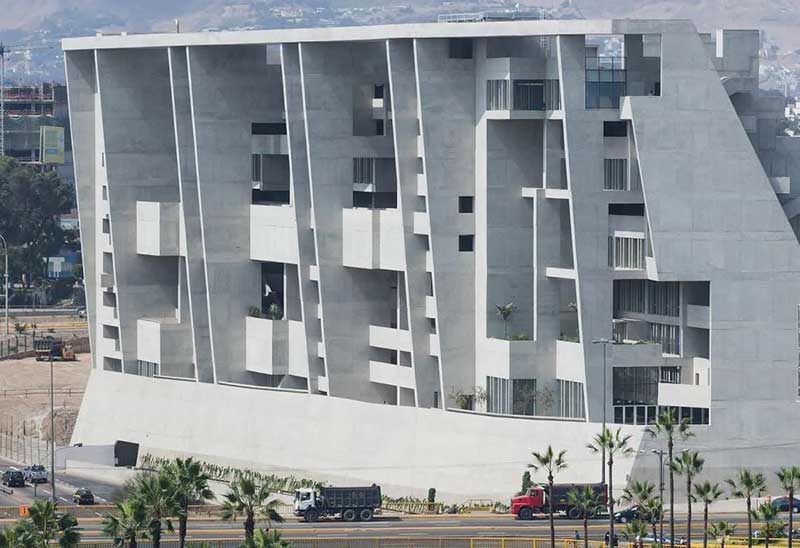
Universidad de Ingeniería y Tecnología, Lima, Peru
Though many critics dismissed the style as cold and oppressive, the philosophy behind it is intended as a source of optimism. In a tumultuous post-war world, brutalist architects sought to rebuild devastated communities through the implementation of affordable, efficient spaces for modern life.
The new style was rooted in the modernist movement which found its beginnings during the Industrial Revolution in the nineteenth century as new methods of engineering and systems for mass production of materials like glass, reinforced concrete, and steel were developed. European architects became inspired to celebrate these recent innovations through the highlight of raw material and a dissuasion from maximalism. Central to this shift was a new generation of young mavericks studying at pioneer architectural institutions – most notably Staatliches Bauhaus – which radically united architects, artists, and designers under the belief that design should serve society as a whole rather than solely aristocratic tastes. This shift in philosophy would prove to forever impact architecture in Europe and America via branches of the modernist movement.
The new style was rooted in the modernist movement which found its beginnings during the Industrial Revolution in the nineteenth century as new methods of engineering and systems for mass production of materials…
By the late nineteenth and early twentieth centuries, architects across Europe had begun rejecting historical revival styles popular at the time which relied heavily on ornamentation and excess. Instead, early modernists focused on clarity, utility, and the purity of material expression. After World War II, many places in Europe faced widespread destruction, housing shortages, and resource scarcity. As a result, architects were tasked with finding an efficient way to rebuild and expand. This set their sights on the newly inexpensive, adaptable concrete as their building medium of choice. Rather than masking the construction with costly decorative facades, architects began to embrace the raw materiality of concrete – exposing it directly and allowing it to become central to their designs.
The term “Brutalism” itself was coined in 1949 by Swedish architect Hans Asplund while describing an unassuming brick residence called Villa Göth in Uppsala, Sweden. The phrase was then later adopted by British architectural critic Reyner Banham in his 1955 essay “The New Brutalism,” published in The Architectural Review, and later in his 1966 book titled The New Brutalism: Ethic or Aesthetic. In his writings, Banham asserted that brutalism was more than simply an architectural style, but rather a philosophical representation of an ethical approach to architecture that centers on transparency, community, and utility.
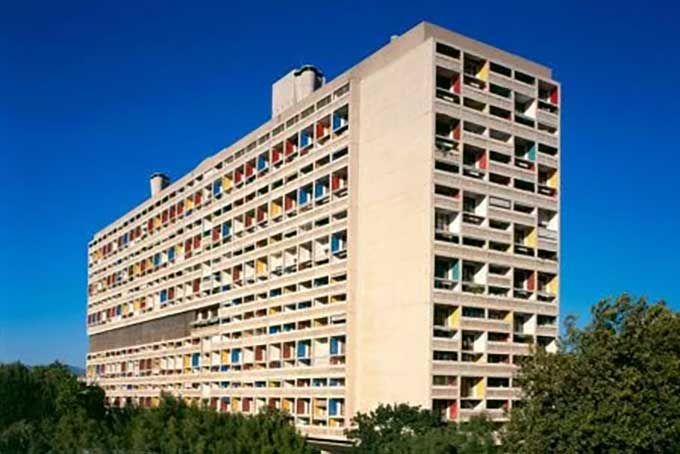
La Cité radieuse, Unité d’habitation, Marseille, France
Among the first leading examples of this new brutalist style was the working class, 18 story housing complex in Marseille, France named La Cité radieuse by Le Corbusier which was built as part of a greater housing scheme called Unité d’habitation. The complex was created to house those displaced from the war with a quick and economical fix. Featuring 337 units, communal areas, and shops, the project functioned almost as a self-contained city.
Brutalist philosophy leans into this idea of efficiency, and foundationally values utility and community. The philosophy aligned closely with socialist and utopian ideas of the time which prioritized collective living and public accessibility, given many of these buildings were created to reimagine architecture as affordable housing projects and community buildings while seeking to address modern needs. In rapidly developing urban areas, architects believed that this mentality could be transformational in the quality of life and development of communities by improving accessibility and coexistence during dark, post-war times. While intended to serve the public, the physicality of these structures often muddied the public perception of the movement.
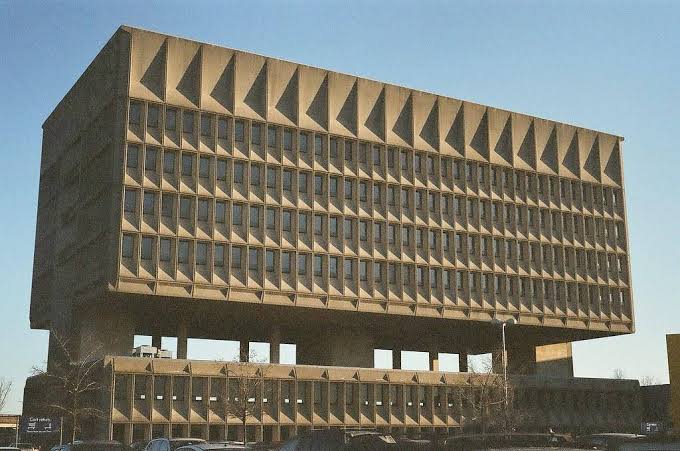
Marcel Breuer’s former Armstrong Rubber Company Headquarters, New Haven, Connecticut
The visual language of brutalism goes beyond exposed concrete. It can be characterized by several key features such as large and often imposing structures, unusual combinations of geometric or modular shapes, high ceilings, monochromatic color palettes, and hidden light sources paired with simple, clean lines. Metallic industrial-style fixtures and occasional wood paneling or imprints on molded concrete sometimes decorate these structures in modest fashion.
Mind-bending compositions can be found throughout a number of brutalist projects. Many of them appear to defy gravity, like architect Marcel Breuer’s former Armstrong Rubber Company Headquarters in New Haven, Connecticut built in 1968 – it features the upper floors of the building precariously teetering on one small support strip down the middle – or Peter Zumthor’s new David Geffen Galleries at the Los Angeles County Museum of Art where a massive amoebic gallery building balances on only a few small structures beneath.
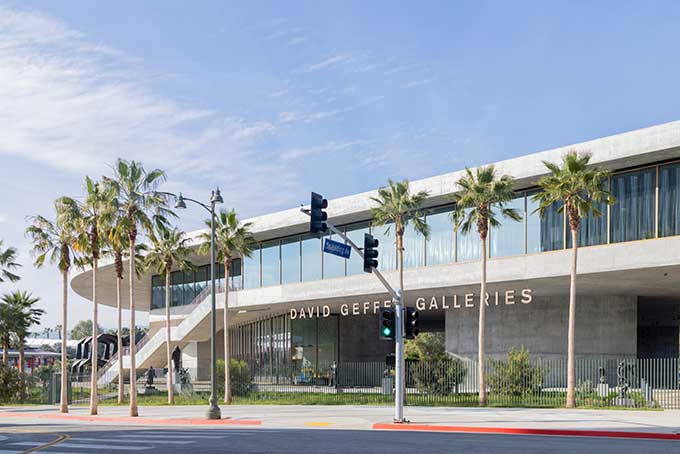
David Geffen Galleries LACMA, Los Angeles, California
While intended as a utopian, functional style, the general public has come to somewhat reject brutalism, viewing these monolithic structures as the exact opposite and inducing a feeling of coldness and totalitarianism among critics. This style has become so controversial that its visual language has even been used as inspiration for depictions of authoritarianism and dystopia in movies like Blade Runner and Star Wars. By refusing to waste resources on decoration, brutalism creates a new problem where, for many, the aesthetics of everyday life can have a significant impact on overall happiness. This dilemma brings up the age-old debate of form versus function where during post-war or other economically depressive times, prioritizing functionality is often a necessity but, in turn, keeps citizens in a rather dreary environment and can exacerbate communal melancholy especially in the wake of national conflict.
Though unpopular for the last few decades, brutalism seems to be having a minor resurgence in recent years with new branches of the style inspiring today’s architects. Substyles like neobrutalism, ecobrutalism, and futuristic brutalism as well as other parallel offshoots of modernism that utilize similar ideas such as structuralism, international style, and minimalism can be seen experimented with and implemented around the world today.
By refusing to waste resources on decoration, brutalism creates a new problem where, for many, the aesthetics of everyday life can have a significant impact on overall happiness.
Among these recent projects is the neobrutalist Universidad de Ingeniería y Tecnología building in Lima, Peru, completed in 2015. The building utilizes many of the classic features of traditional brutalism with new innovations and a modern-day flair like its hallmark sense of grandiosity, responsiveness to the surrounding community and environment, recessed elements, as well as exposed study areas which allow for a transparent exchange of ideas between students. The dynamic, vertical structure has been compared to a modern-day Machu Picchu with open gathering spaces, stepped terraces, and impressive climate engineering.
Looking to the future of brutalism, ideology has seemed to shift towards the incorporation of more environmentally friendly construction, seen especially in the emergence of eco-brutalism. This style adds to the utilitarian ideology of brutalism with a focus on deeply intertwining nature and sustainability into human spaces. While most structures are built separately from green spaces, eco-brutalism marries the two into paradoxical, living structures. Italian architect and urban planner Stefano Boeri Architetti aims to bring eco-brutalism into cities around the world with his groundbreaking idea of “forest cities.” Integrating the natural world within metro areas allows us to get the best of both worlds – clean air, lush beauty, and comfortable living. Finished in 2014, Bosco Verticale in Milan, Italy serves as one of the first large-scale prototypes for this radical idea. Translating to “vertical forest,” these twin structures tower hundreds of feet above the city, housing hundreds of residents as well as over 20,000 trees and shrubs, gracefully cascading down the facades between balconies. Specific plant species were meticulously chosen to utilize their natural functionality, placing different species in curated spots that would best suit their needs. This type of Bauhaus thinking allows this one project to house fifty times more vegetation in its area than would normally be possible and contributes to the reduction of CO2 as well as noise pollution in the city. To further the reduction on the residence’s carbon footprint, recycled graywater is used for many of the building’s needs. While brutalism is often criticized for its melancholic appearance, eco-brutalism defies the form versus function debate by utilizing the beauty of flora to naturally decorate these monochromatic structures into colorful, stunning visual forms. By merging these two ideas of utility and environmentalism, Bosco Verticale sets the playing field for the eco-brutalist movement, showing that large-scale concrete architecture can coexist with and actively support the natural environment rather than compete with it.
As it has evolved, brutalism has grown beyond simple aesthetics defined by exposed concrete and monumental forms. It has come to represent a new way of navigating life, shaped by hardships and solutions that sought to address urgent social needs through purity, functionality, and collective living. While public opinion has long oscillated between admiration and disdain, the movement’s core ideals continue to resonate as contemporary architects confront new challenges such as housing shortages, climate change, and sustainable urban development.
Today’s reinterpretations demonstrate that brutalism is an evolving architectural language capable of adapting to the needs of the present rather than a relic of time’s past. Whether expressed through the bold geometry of neobrutalism or the living cities of eco-brutalism, the movement continues to challenge our assumptions about beauty, purpose, and the role that architecture plays in shaping society.